Insights
Let's Talk →

AI for Manufacturing

From the shop floor to the supply chain — computer vision, predictive models, and agents that turn machine and sensor data into uptime, quality, and throughput.

The Landscape

The data is already on the line. The value is in acting on it.

Modern plants are saturated with data — PLCs, MES, vision systems, IoT sensors, ERP — yet most of it is logged and forgotten. The opportunity in manufacturing isn't more instrumentation; it's turning the signal you already capture into decisions: which machine to service before it fails, which unit to pull before it ships, how to schedule a line for maximum yield.

AI in manufacturing rarely succeeds as a science project bolted onto the edge of operations. It works when it's grounded in the realities of the floor — OT/IT boundaries, intermittent connectivity, safety-critical processes, and operators who need answers in seconds, not dashboards to interpret later.

We build for those constraints. The use cases below are the ones that consistently return measurable value: defect detection that catches escapes before they reach a customer, maintenance that's scheduled by condition rather than calendar, and planning that lifts OEE without new capital equipment.

High-Value Use Cases

Where AI pays off on the floor.

Six production-ready use cases, each mapped to the AdeptivIQ capability that powers it.

Computer Vision AI

Automated Visual Quality Inspection

Camera-based inspection that flags surface defects, missing components, and assembly errors in real time — at line speed, on every unit, not just a sampled few. Models adapt to new product variants without re-tooling the rig.

  • Outcome — fewer defect escapes, less scrap, and inspection that scales to 100% of output.
Predictive AI

Predictive Maintenance

Condition-based models that learn the vibration, temperature, and current signatures of healthy equipment and warn before failure — replacing fixed-interval servicing with maintenance scheduled by actual machine health.

  • Outcome — less unplanned downtime, longer asset life, and lower maintenance spend.
Predictive AI

Supply Chain & Demand Forecasting

Forecasts that blend order history, seasonality, lead-time variability, and external signals to right-size inventory and anticipate disruption — across raw materials, WIP, and finished goods.

  • Outcome — lower carrying costs, fewer stockouts, and a more resilient supply base.
Predictive + Agentic AI

Production Scheduling & Yield Optimization

Optimization that sequences jobs, balances lines, and tunes process parameters against changing constraints — minimizing changeovers and lifting first-pass yield without new capital equipment.

  • Outcome — higher OEE and throughput from the assets you already run.
Hybrid Generative AI

Shop-Floor Knowledge Assistant

An assistant grounded in your SOPs, machine manuals, maintenance logs, and tribal know-how — so a technician can ask "why is line 3 throwing this fault?" and get a sourced, actionable answer in seconds.

  • Outcome — faster troubleshooting and knowledge that survives retirements and shift changes.
Computer Vision AI

Worker Safety & Compliance Monitoring

Vision models that detect missing PPE, unsafe proximity to equipment, and restricted-zone entry — alerting in real time and surfacing patterns before they become incidents, with privacy-preserving design.

  • Outcome — fewer recordable incidents and a defensible, proactive safety record.
Featured Use Case

Visual quality inspection, in depth.
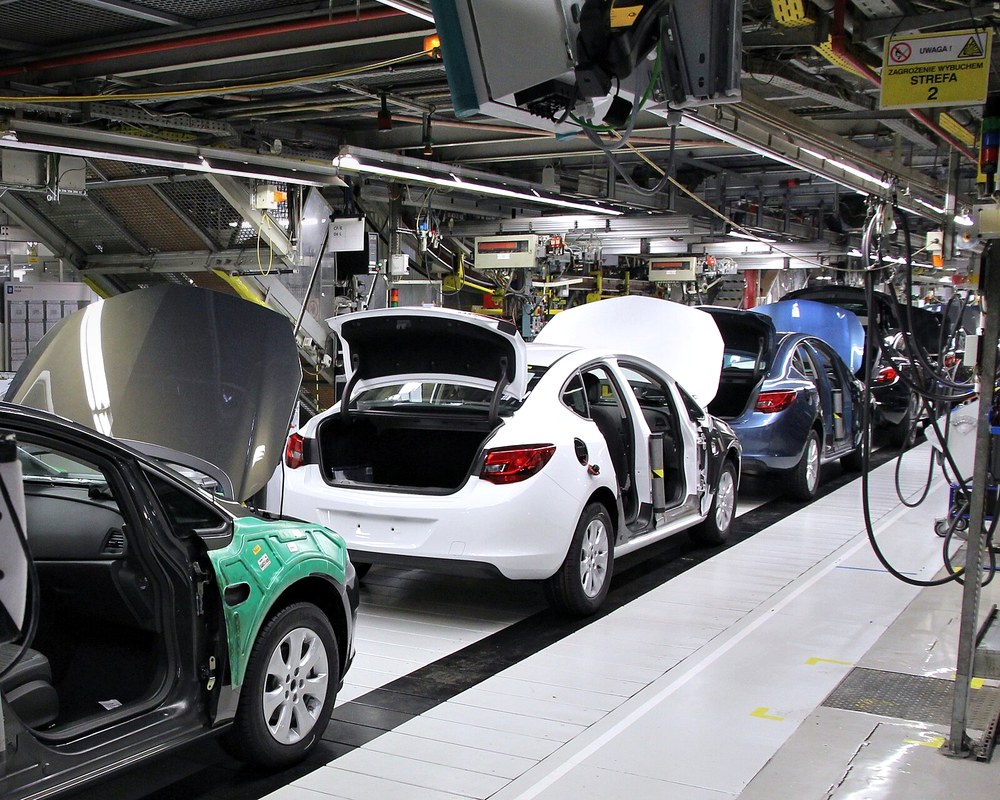
A vehicle assembly line — computer vision inspecting every unit, not just a sample
inspect every unit,
not a sample
COMPUTER VISION
FROM SAMPLE TO 100%

Catch the defect before it ships — on every unit

Traditional QA inspects a sample and infers the rest. That works until a process drifts mid-run and a batch of escapes reaches a customer. Computer vision changes the economics: every unit is inspected, at line speed, by a model trained on your own good-and-bad examples.

We start with a tightly scoped defect class and a camera setup that fits your line, prove accuracy against your inspectors, then expand coverage and feed findings back into process control — so inspection becomes an early-warning system for the process itself, not just a gate at the end of it.

Defect classificationAnomaly detectionEdge deploymentHuman-in-the-loop reviewProcess feedback
Capabilities That Apply

The building blocks behind manufacturing AI.

Each use case above is powered by one or more of our core capabilities.

Ready to put AI to work in manufacturing?

Tell us where you are today — a line, a defect, a maintenance headache — and we'll map the fastest path to measurable impact. No jargon, no overselling.

Talk to us about manufacturing AI